



Why linen? The facts.
More Than Just Aesthetics: How Linen Sustainably Transforms Your Sleep – and Our Environment.
You probably grew up with cotton. That's completely normal – it's soft, familiar, and has been the standard for bedding for decades. However, we are convinced: once you've felt the difference on your skin, you rarely go back.
For us, linen is not a trend, but a conscious decision. For a balanced sleep climate, for longevity, and for materials with true character. Here, we share the most important facts – objectively, transparently, and without exaggeration.
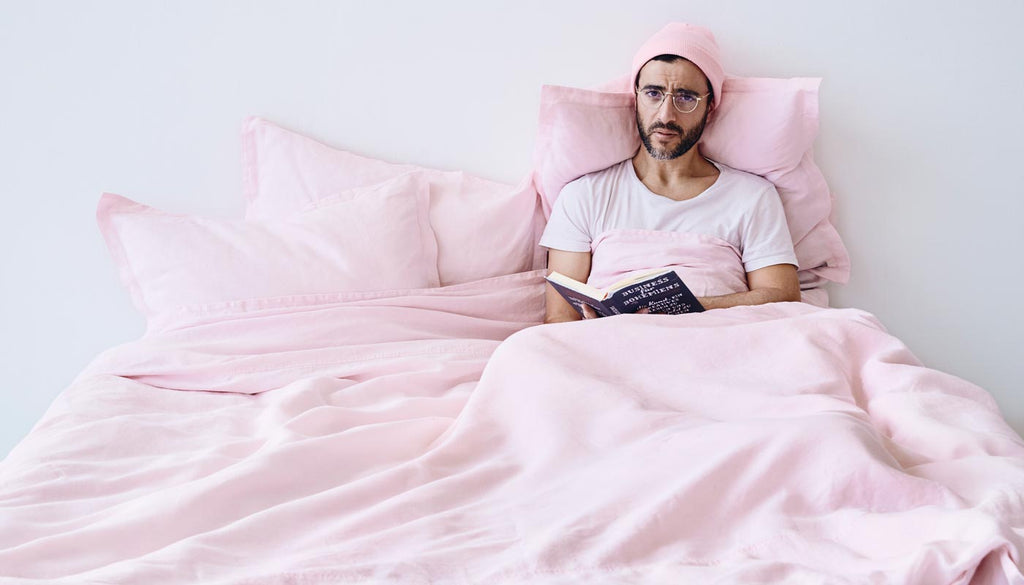
We spend a third of our lives sleeping. What you sleep in should be a conscious decision.
Warm in winter, cool in summer
Linen possesses an exceptional ability to regulate temperature. The thermal conductivity of linen is significantly higher than that of many other natural fibers, which is why flax is also used as an insulating material. In summer, linen feels pleasantly cool and supports the body's natural heat balance. In winter, it reliably retains body heat. This balance ensures a calm, consistent sleeping experience all year round – regardless of room temperature.
Less sweating, more comfort
An often underestimated quality of linen is its moisture regulation. Linen absorbs moisture and quickly releases it again. The fabric dries quickly, does not stick to the skin, and allows air to circulate freely. Studies show that people sweat significantly less in linen than in cotton or viscose. The skin can breathe, and the body's climate remains stable - a noticeable difference, especially on warm nights.
A material with responsibility
Textile production consumes water, energy, and resources that are rarely seen in everyday life. Flax, the basis of linen, is naturally robust and requires very few chemicals compared to many other fibers. In contrast to conventional cotton, flax uses significantly fewer pesticides and hardly any additional irrigation. In addition, the plant returns nutrients to the soil and can be well integrated into sustainable crop rotations.
Naturally antibacterial & skin-friendly
Linen is naturally antibacterial and inhibits bacteria and fungi. These properties were utilized early on – including in the medical field. Linen is particularly suitable for people with sensitive skin or allergies. The fabric is breathable, temperature-regulating, and offers mites little habitat. A restful night's sleep often begins with the right material.
Easy care – no ironing required
Linen is allowed to wrinkle. And that's exactly what defines its character. Ironing consumes many times more energy than washing – and with linen, it's simply not necessary. The fabric's natural texture is now consciously valued as part of a timeless, modern living style.
Robust, durable, dimensionally stable
Linen fibers are longer and more durable than many other natural fibers, making linen particularly long-lasting. While classic cotton bedding often needs replacing after a few years, high-quality linen bedding, with proper care, can last for many years. Even after frequent washing, linen retains its shape. The bed always looks well-kept – a detail that makes a big difference in everyday life.
Softness that grows with time
Linen gets softer with every wash, without losing its quality. The material remains lightweight, comfortable against the skin, and develops a special suppleness over time. A sleeping experience that doesn't diminish – but improves.
Colors with Responsibility
Natural linen's color ranges from ivory to taupe. Lighter or bolder colors are achieved through dyeing – when done responsibly, this is not a problem. We use dyes from the Swiss company CHT Bezema, known for its high standards in quality and environmental compatibility. Many other fibers require intensive dyeing and washing processes that consume large amounts of water and produce contaminated wastewater.
Price & Value
Linen accounts for less than one percent of global fiber production. Processing is demanding, time-consuming, and requires experience. European production and fair working conditions also contribute to the price. Linen is not a cheap material – but it is one with substance. Those who choose linen invest in durability, comfort, and quality that will impress for years to come.
Biodegradable
Linen is completely biodegradable and decomposes in the soil within a few weeks. A material that not only looks and feels good but also uses resources responsibly.
When choosing bedding, it's worth taking a closer look. Linen from European cultivation, in pure quality and without mixed fibres, is a conscious choice.
And as with many things, a large part of the ecological footprint only arises after purchase – through care and use. With proper care, this can be significantly reduced.
You can find more information in our guide to proper linen care.

